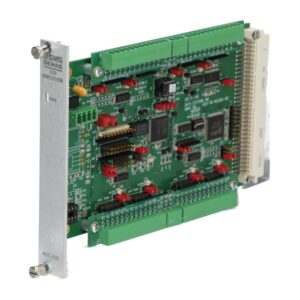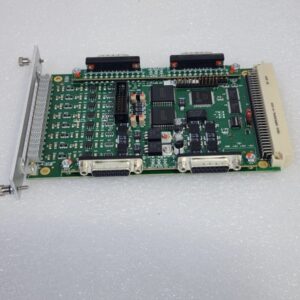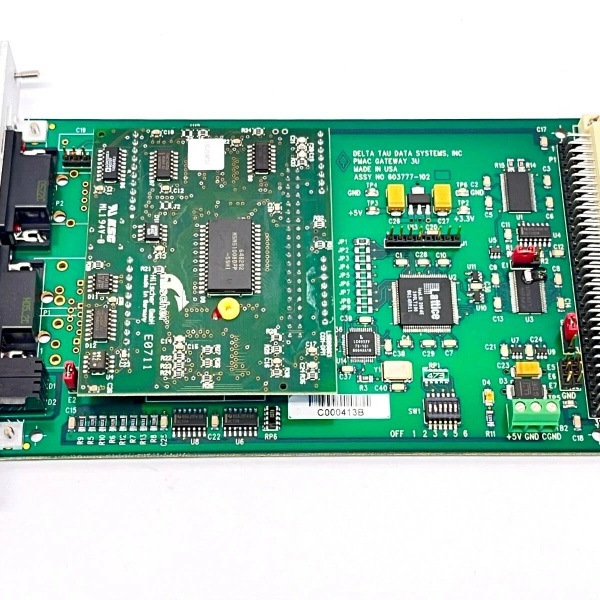
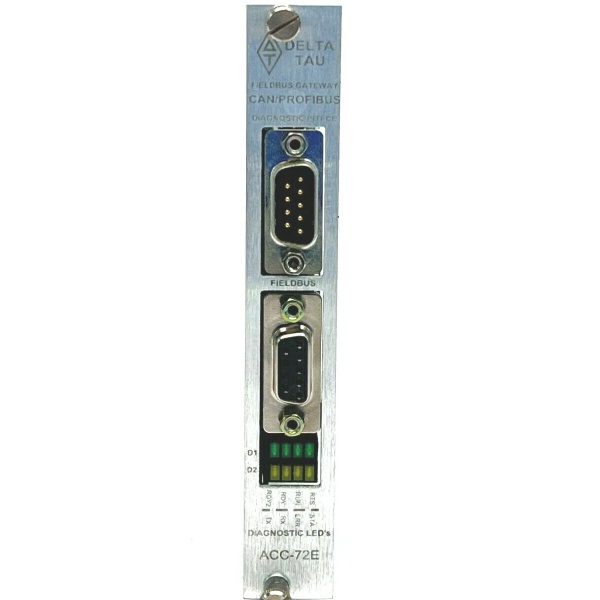
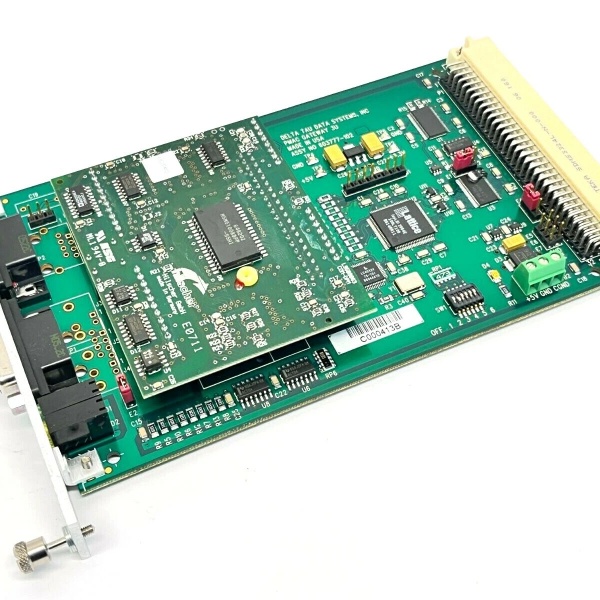
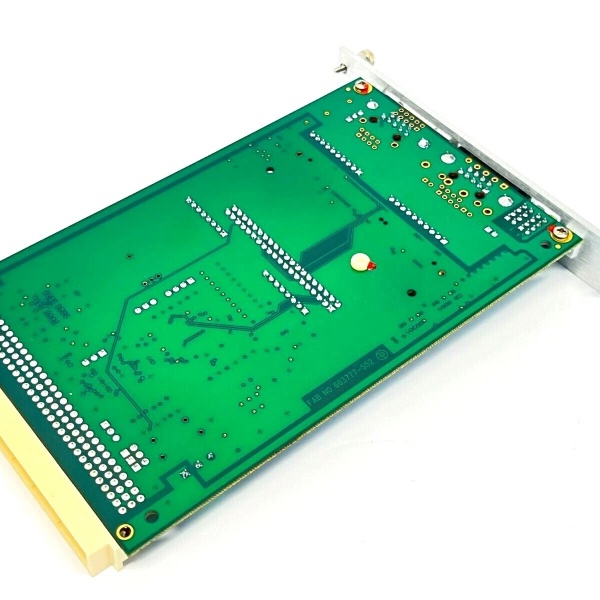
ACC-72E: Product OverviewThe DELTA TAU ACC-72E is a high-density servo interface accessory board designed for the Turbo PMAC2 motion controller platform, providing multi-axis analog servo control for complex motion applications requiring coordinated control of multiple axes. This board serves as an interface between the Turbo PMAC2 motion controller and analog servo drives, converting digital motion commands from the controller into analog voltage signals for drive control while processing encoder feedback for closed-loop position control. The module operates within the Turbo PMAC2 system architecture, significantly expanding the controller’s capability to manage additional servo axes beyond its built-in capacity.Installed as an accessory to the main Turbo PMAC2 CPU board, this interface handles six independent servo channels, each capable of generating ±10V analog command signals to drive servo amplifiers. The board processes quadrature encoder feedback with 24-bit resolution, providing precise position tracking for high-accuracy motion applications. Each channel supports multiple feedback types including incremental encoders, absolute serial encoders, and resolver interfaces, making it suitable for various motor and feedback device configurations. The architecture includes dedicated processing for servo loop closure, offloading computational burden from the main CPU while maintaining tight synchronization with other axes in multi-axis coordinated motion systems.As part of the Turbo PMAC2 product family, this accessory board integrates seamlessly with the platform’s motion control capabilities, supporting advanced features such as electronic gearing, cam profiling, and coordinated multi-axis interpolation. The system maintains deterministic update rates for servo loops, typically operating at 4 kHz or higher depending on configuration, ensuring stable and responsive motion control. This integration allows engineers to scale motion control systems by adding axis capacity while maintaining consistent performance characteristics across all controlled axes.
ACC-72E
ACC-72E: Technical Specifications
• Model Number: ACC-72E
• Manufacturer: DELTA TAU
• Product Type: Turbo PMAC2 Accessory Board
• Number of Axes: 6 independent servo channels
• Analog Output: ±10V differential, 16-bit resolution
• Feedback Types: Incremental encoder, absolute serial encoder, resolver
• Servo Update Rate: Configurable up to 44 kHz
• Communication Interface: Parallel bus to Turbo PMAC2 CPU
• Power Supply: +5V DC from host controller
• Operating Temperature: 0°C to 60°C
• Storage Temperature: -40°C to 85°C
• Connector Type: Two 50-pin high-density D-sub connectors
• Isolation: 500V optical isolation on encoder inputs
• Power Consumption: 5W typical
• Compatibility: All Turbo PMAC2 CPU models
ACC-72E
Core Features & Customer ValueHigh-Density Axis Configuration: The six-axis capability provides significant channel density in a single slot, reducing the number of boards required for multi-axis systems. This high channel count is particularly valuable for complex machinery requiring coordinated control of multiple axes, such as robotic systems, multi-axis machining centers, and complex material handling equipment. The benefit for system integrators is reduced hardware complexity and improved reliability through fewer interconnections and components.High-Resolution Motion Control: The 16-bit analog output resolution combined with 24-bit encoder feedback provides precise command signal generation and accurate position tracking. This high resolution enables smooth motion profiles with minimal quantization effects, particularly important for applications requiring fine velocity control or precise positioning at low speeds. The benefit for machine builders is improved motion quality and positioning accuracy, reducing settling times and increasing throughput in precision automation applications.Flexible Feedback Integration: Support for multiple feedback types allows the interface to work with various motor and encoder technologies without requiring additional signal conditioning hardware. The ability to handle incremental encoders, absolute serial encoders (such as EnDat, BiSS, or SSI), and resolver inputs provides system integrators with flexibility in component selection and simplifies retrofitting of existing equipment. This flexibility reduces engineering time and component costs when designing or upgrading motion systems.Deterministic Servo Performance: The dedicated processing architecture ensures consistent servo update rates independent of the main CPU’s computational load. This deterministic behavior provides stable servo control essential for high-performance applications involving high gains, stiff mechanics, or complex motion profiles. For applications such as CNC machining or electronic assembly, this stability translates to better surface finishes, higher placement accuracy, and reduced mechanical vibration.Typical ApplicationsIn robotic systems, the interface controls multiple joints simultaneously, providing coordinated motion for articulated arm robots, SCARA robots, or delta robots. The six-axis capacity matches well with typical robotic configurations, allowing control of all primary axes from a single board while maintaining tight synchronization between joints for smooth trajectory execution.For multi-axis CNC machining centers, the board controls XYZ linear axes plus rotational axes for complex 5-axis machining operations. The high channel count supports simultaneous control of all machine axes, enabling complex contouring and surface machining operations that require precise coordination between multiple degrees of freedom.In semiconductor manufacturing equipment, the module controls precision stages for wafer handling, inspection, and processing systems requiring multiple coordinated axes. Applications include stepper/scanner systems for photolithography, wafer probing systems, and automated material handling systems where multiple axes must work in precise synchronization.In packaging and converting machinery, the interface manages multiple servo axes for web handling, printing, and converting operations. The deterministic update rates ensure precise timing coordination between axes operating at high production speeds, maintaining registration accuracy in multi-station processing lines.
We've got you covered
We give you access to a global supply of automation parts at your fingertips, ensuring that manufacturers around the world can avoid unnecessary downtime and continue to do what they do best – making our world possible.
Full 12-month warranty on all components
Dedicated after-sales support
Same-day dispatch on 1000s of parts
All units are fully tested
Continue Searching
We're here when you need us
What happens next?
1. Email confirmation
You will get an email confirming that we have received your enquiry.
2. Dedicated Account Manager
One of our team will be in touch to confirm your part(s) specification and condition.
3. Your quote
You will receive a comprehensive quote tailored to your specific needs.