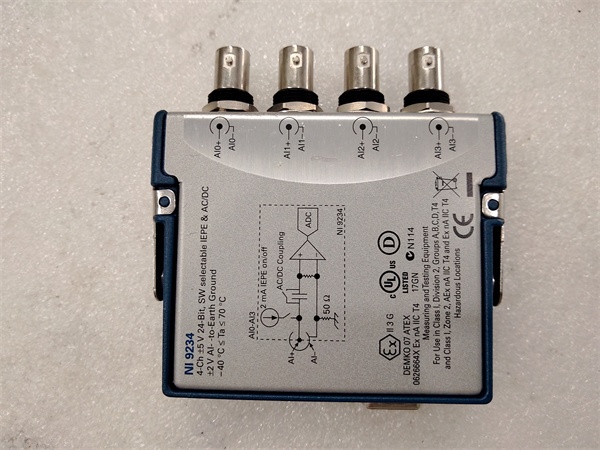
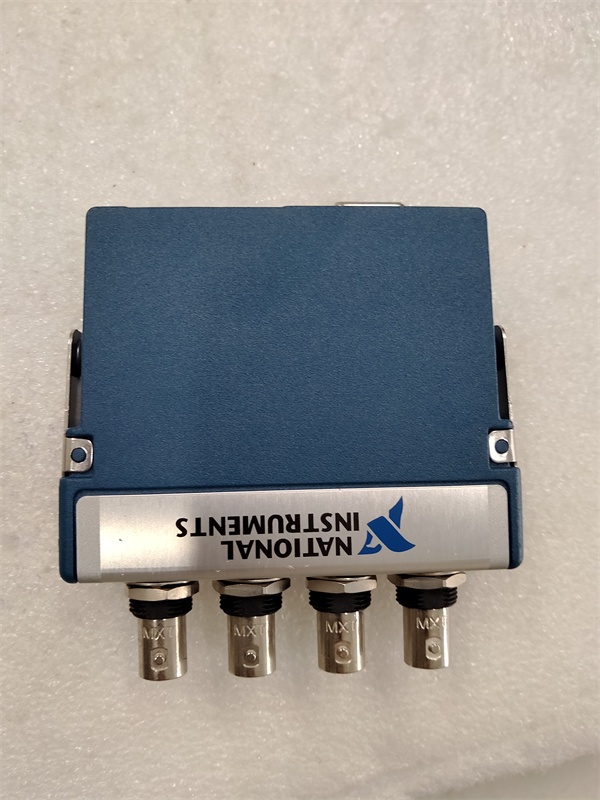
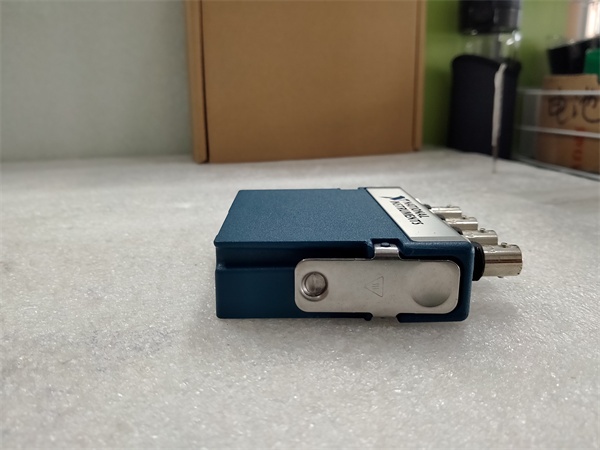
Description
System Architecture & Operational Principle
The NI 9234 is a 4-channel dynamic signal acquisition module belonging to NI’s C-Series, designed for Purdue Model Level 1 (Process Control) in industrial automation. It serves as the critical interface between field sensors (e.g., vibration accelerometers, acoustic microphones) and upstream data processing systems (e.g., LabVIEW workstations, industrial PCs).
Core Functional Blocks
-
Signal Conditioning:
-
IEPE Excitation: Provides a 2 mA constant-current source to power IEPE sensors (e.g., piezoelectric accelerometers), eliminating the need for external power supplies.
-
AC/DC Coupling: Software-selectable to isolate DC offsets (AC coupling, 0.5 Hz cutoff) or retain static signals (DC coupling), adapting to different measurement scenarios (e.g., vibration vs. displacement).
-
Anti-Aliasing Filter: Automatically adjusts cutoff frequency based on the sampling rate to suppress high-frequency noise, ensuring signal integrity.
-
-
Analog-to-Digital Conversion (ADC):
-
A 24-bit Delta-Sigma ADC per channel achieves a 102 dB dynamic range, enabling precise capture of weak signals (e.g., early-stage bearing faults) and strong signals (e.g., gear meshing frequencies) without saturation.
-
Synchronous Sampling: All 4 channels sample simultaneously at rates up to 51.2 kS/s, ensuring time consistency for multi-sensor applications (e.g., 3D vibration analysis).
-
-
Digital Signal Processing (DSP):
-
Onboard DSP performs real-time filtering (e.g., low-pass, band-pass) and scaling, reducing the computational load on the host system.
-
TEDS Support: Automatically reads calibration parameters from smart sensors (via IEEE 1451.4 TEDS), simplifying configuration and minimizing human error.
-
-
Communication Interface:
-
Connects to NI CompactDAQ/CompactRIO chassis via a 32-bit PCI/PCIe bus, providing high-speed data transfer (up to 132 MB/s) to the host computer.
-
Compatible with NI-XNET driver for seamless integration with LabVIEW, LabWindows/CVI, and third-party software (e.g., MATLAB).
-
Operational Workflow
-
Sensor Connection: IEPE/non-IEPE sensors are connected to the NI 9234 via BNC connectors. The module supplies excitation current (if enabled) and conditions the signal (filtering, coupling).
-
Sampling & Digitization: The ADC converts the conditioned analog signal to a 24-bit digital value, with synchronous sampling across all channels.
-
Data Transfer: Digital data is transmitted to the host computer via the chassis bus. The NI-XNET driver parses the data and makes it available to applications like LabVIEW.
-
Analysis & Action: The host system processes the data (e.g., FFT, order tracking) to extract insights (e.g., fault diagnosis, noise source localization). Results are used to trigger actions (e.g., maintenance alerts, process adjustments).

NI 9234
Core Technical Specifications
|
Parameter
|
Specification
|
|---|---|
|
Channels
|
4 differential analog inputs
|
|
Resolution
|
24-bit Delta-Sigma ADC
|
|
Sampling Rate
|
Up to 51.2 kS/s per channel (synchronous)
|
|
Input Range
|
±5 V (max)
|
|
Dynamic Range
|
102 dB (typical)
|
|
Coupling
|
Software-selectable AC (0.5 Hz cutoff) / DC
|
|
IEPE Excitation
|
2 mA constant current (software-enableable)
|
|
Filter
|
Anti-aliasing (automatic cutoff adjustment)
|
|
Connector
|
4x BNC (female)
|
|
Bus Interface
|
32-bit PCI/PCIe (compatible with CompactDAQ/CompactRIO)
|
|
Operating Temperature
|
-40°C to +70°C (ambient, non-condensing)
|
|
Power Consumption
|
≤2 W (from chassis bus)
|
|
Certifications
|
CE, UL, cUL, NIST (calibration traceable)
|
Customer Value & Operational Benefits
1. High Precision for Early Fault Detection
The 24-bit resolution and 102 dB dynamic range enable the NI 9234 to detect weak fault signatures (e.g., bearing wear, gear tooth cracks) that would be masked by noise in lower-resolution systems. For example, in wind turbine gearboxes, the module can capture micro-vibrations (μV-level) indicative of early-stage damage, allowing predictive maintenance and reducing unplanned downtime by 30–50%.
2. Flexible Integration with Existing Systems
The NI 9234’s compatibility with CompactDAQ/CompactRIO chassis and NI-XNET driver allows seamless integration with legacy systems (e.g., PLCs, HMIs) and modern software (e.g., LabVIEW, MATLAB). This flexibility eliminates the need for costly system overhauls—for instance, a manufacturing plant can upgrade its vibration monitoring system by adding NI 9234 modules to existing CompactDAQ chassis.
3. Rugged Reliability for Harsh Environments
The module’s -40°C to +70°C operating temperature range and shock/vibration resistance (5 g vibration, 50 g shock) make it suitable for harsh industrial environments (e.g., outdoor wind farms, factory floors). The NIST calibration ensures compliance with international standards (e.g., ISO 10816), providing trustworthy measurements for regulatory and quality assurance purposes.
4. Cost Savings via Reduced Maintenance
By enabling predictive maintenance (instead of reactive repairs), the NI 9234 reduces maintenance costs by 20–40%. For example, a paper mill using the module to monitor dryer section vibrations can avoid costly roll failures by detecting bearing wear early, saving $10,000–$50,000 per incident.
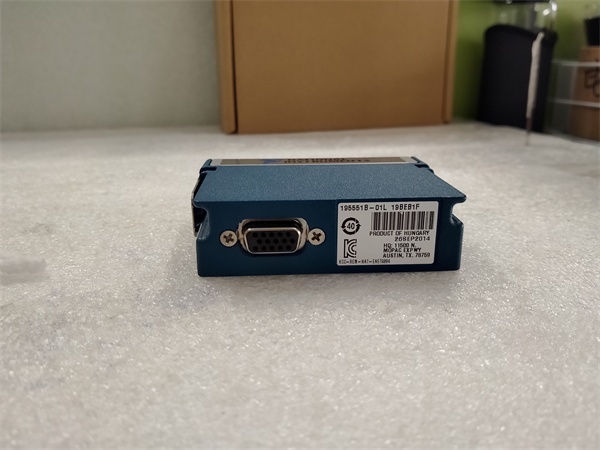
NI 9234
Field Engineer’s Notes (From the Trenches)
When installing the NI 9234, always use shielded BNC cables (e.g., Belden 9841) to minimize electromagnetic interference (EMI). I once saw a site lose 8 hours of production because unshielded cables picked up noise from nearby motors, leading to false fault alarms.Enable IEPE excitation only for IEPE sensors—leaving it on for non-IEPE sensors (e.g., strain gauges) can damage the sensor or module. Use a multimeter to verify the sensor’s power requirement before connecting.Calibrate the module annually using NI’s calibration service (traceable to NIST). A 2024 calibration of a wind turbine module revealed a 0.5% gain error, which was corrected to maintain measurement accuracy.Use the anti-aliasing filter—disable it only if you’re certain the input signal has no high-frequency components above the Nyquist rate. I once forgot to enable it, resulting in aliased noise that invalidated a week’s worth of vibration data.
Real-World Applications
1. Wind Turbine Gearbox Monitoring
A wind farm uses NI 9234 modules to monitor the vibration of 100+ wind turbines. Each turbine has a 3-axis accelerometer connected to the module, which samples at 51.2 kS/s. The data is processed in LabVIEW to perform order tracking (correlating vibration with rotor speed) and envelope analysis (detecting bearing faults). This system has reduced unplanned downtime by 40% and increased energy output by 5% (due to fewer maintenance shutdowns).
2. Automotive NVH Testing
An automotive manufacturer uses the NI 9234 to measure noise and vibration in a new SUV. The module is connected to microphones (inside the cabin) and accelerometers (on the engine and suspension). LabVIEW’s Sound and Vibration Assistant is used to perform fractional-octave analysis (identifying dominant noise sources) and modal analysis (optimizing suspension design). The result is a 10% reduction in cabin noise, improving customer satisfaction.
3. Semiconductor Wafer Fabrication
A semiconductor fab uses the NI 9234 to monitor the vibration of wafer processing equipment (e.g., lithography machines). The module’s 24-bit resolution captures micro-vibrations (μm-level) that can affect wafer alignment. By correlating vibration data with yield rates, the fab has improved wafer良率 by 2% (equivalent to $1 million/year in savings).