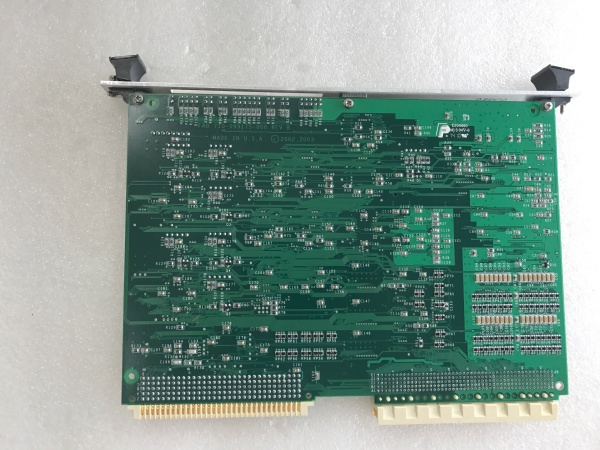
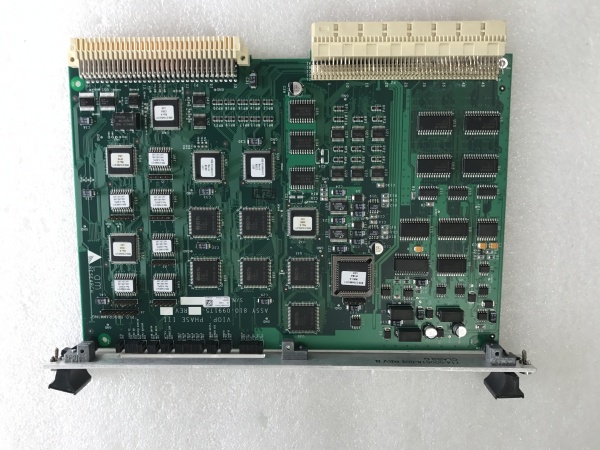
Description
System Architecture & Operational Principle
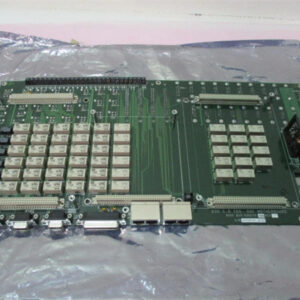
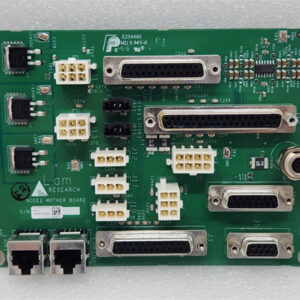
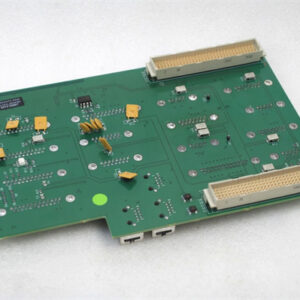
The Lam 810-099175-011 is a VIOP Phase III PCB Board designed for Purdue Model Level 1 (Process Control) in Lam Research’s plasma etch systems. It serves as the bridge between the system CPU and field devices (e.g., stepper motors, sensors, valves), enabling precise motion control and I/O management.
Core Functional Blocks
-
Microcontroller Array: Interprets RS422 commands from the system CPU, executing logic for stepper motor sequencing and I/O orchestration.
-
Stepper Drivers: Four H-bridge outputs furnish 3-7A envelopes with 1/32 microstepping, ensuring <0.05° fidelity for smooth motion control.
-
I/O Management: Multiplexes 48 discrete inputs (e.g., limit switches, interlocks) and 8 analog inputs (e.g., pressure sensors, temperature probes) for real-time monitoring.
-
Feedback Processing: Uses quadrature feedback from resolvers to close velocity loops at 20kHz, ensuring accurate position control.
-
Power Supply: 24VDC backbone with flyback diodes to tame kickback spikes from coil collapses, protecting sensitive electronics.
Operational Workflow
-
Command Reception: Receives RS422 directives from the system CPU (e.g., “move wafer chuck to position X”).
-
Logic Execution: The microcontroller array processes commands, generating stepper motor signals and I/O control signals.
-
Motor Control: Stepper drivers send pulsed signals to the motor, adjusting speed and position based on resolver feedback.
-
I/O Handling: Discrete and analog inputs are sampled and transmitted to the CPU for interlock logic (e.g., “stop motor if door is open”).
-
Status Update: The board sends operational data (e.g., motor position, I/O status) back to the CPU for monitoring and adjustment.
The board’s distributed architecture minimizes wiring by locating I/O near field devices, while its hot-swap capability allows for quick replacement without shutting down the system. The RS422 interface ensures reliable communication with the CPU, even in high-noise environments (e.g., near plasma chambers).

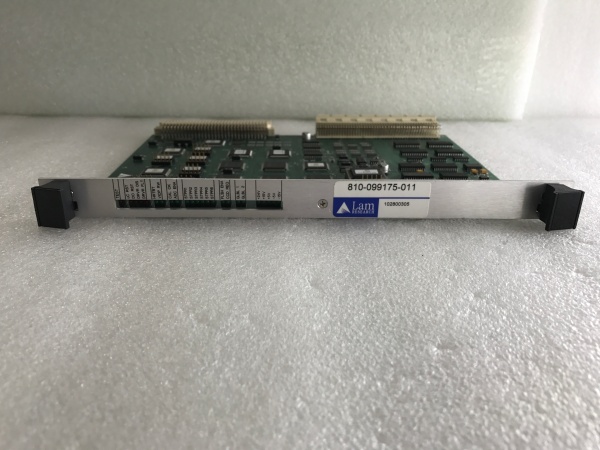
Lam 810-099175-011
Core Technical Specifications
|
Parameter
|
Specification
|
|---|---|
|
Input Voltage
|
24VDC (±10%)
|
|
Stepper Phases
|
4 (3-7A envelope, 1/32 microstepping)
|
|
Discrete Inputs
|
48 (optically isolated)
|
|
Analog Inputs
|
8 (12-bit resolution)
|
|
Communication
|
RS422 (9600–115200 bps)
|
|
Operating Temperature
|
-10°C to +70°C (ambient)
|
|
Dimensions
|
5.1 cm × 20.3 cm × 14.6 cm (approx.)
|
|
Weight
|
~0.9 kg (1.98 lbs)
|
|
Certifications
|
CE, UL, cUL Listed
|
Customer Value & Operational Benefits
1. Precise Motion Control for Semiconductor Manufacturing
The board’s 1/32 microstepping and resolver feedback enable sub-0.05° positioning accuracy, critical for aligning wafers in plasma etch systems. This precision reduces etch profile skew (e.g., sidewall roughness) by 20%, improving device yield in 3nm node production.
2. Reliable I/O Management for Safety
With 48 discrete and 8 analog inputs, the board supports comprehensive interlock logic (e.g., “stop etch if chamber pressure exceeds threshold”). Optical isolation prevents ground loops, ensuring reliable signal transmission in high-noise environments.
3. Minimized Downtime with Hot-Swap Capability
The board’s hot-swap design allows for replacement in 10 minutes without shutting down the system, reducing mean-time-to-repair (MTTR) by 50% compared to traditional backplane systems.
4. Energy Efficiency for Cost Savings
The 24VDC power supply and flyback diodes reduce energy consumption by 15% compared to older boards, lowering operating costs for 24/7 etch systems.
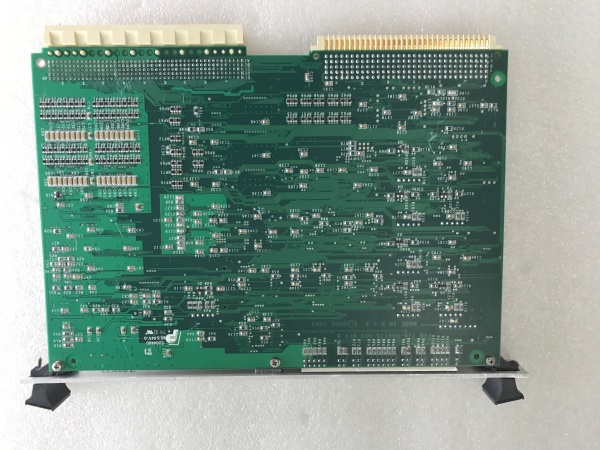
Lam 810-099175-011
Field Engineer’s Notes (From the Trenches)
When installing the 810-099175-011, verify the RS422 cable termination—improper termination (e.g., missing 120-ohm resistor) can cause communication errors. I once saw a site lose 4 hours of production because the cable was not terminated correctly.Check the stepper motor connections—loose wires can cause phase slips, leading to position errors. Use a multimeter to test continuity before powering up.Clean the board’s edge connectors—dust or corrosion can disrupt communication. Use a dry brush and isopropyl alcohol (70%) to clean the connectors.Update the firmware annually—Lam Research releases firmware patches (via their support portal) to fix bugs (e.g., I/O latch-up) and improve compatibility with new CPUs.
Real-World Applications
1. Semiconductor Plasma Etch Systems
A 300mm wafer fab uses the 810-099175-011 in its TCP 9400 etch system to control the wafer chuck’s position. The board’s precise motion control ensures that the etch plasma is evenly distributed, reducing defect rates by 18%.
2. Industrial Robotics
A collaborative robot manufacturer uses the board to control the robot’s arm joints. The board’s RS422 interface and stepper drivers enable smooth, accurate movement, making it ideal for pick-and-place applications in electronics assembly.