Description
System Architecture & Operational Principle
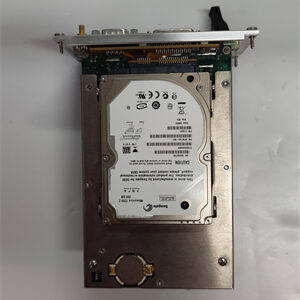
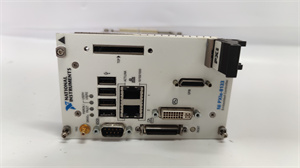
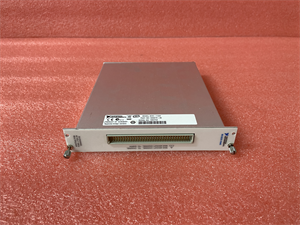
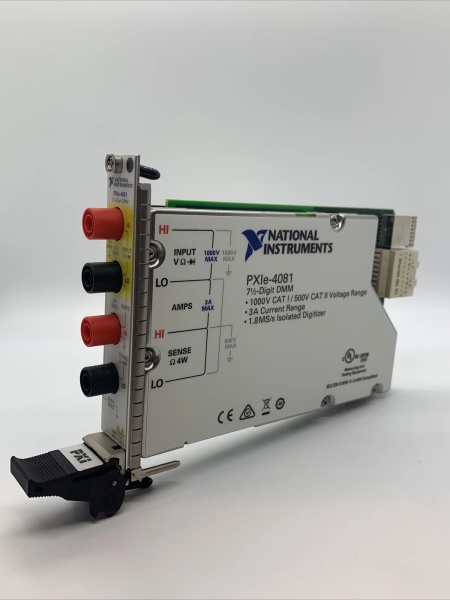
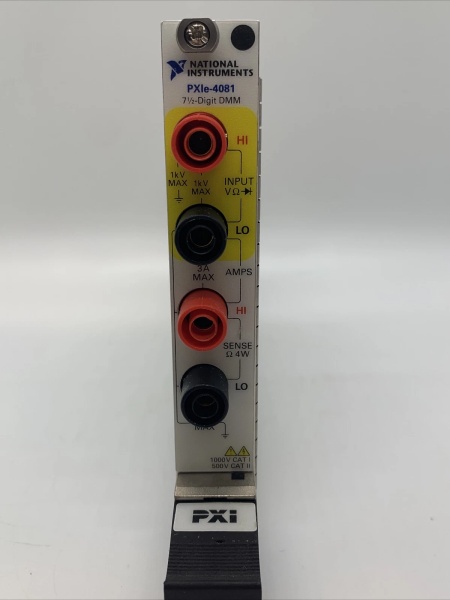
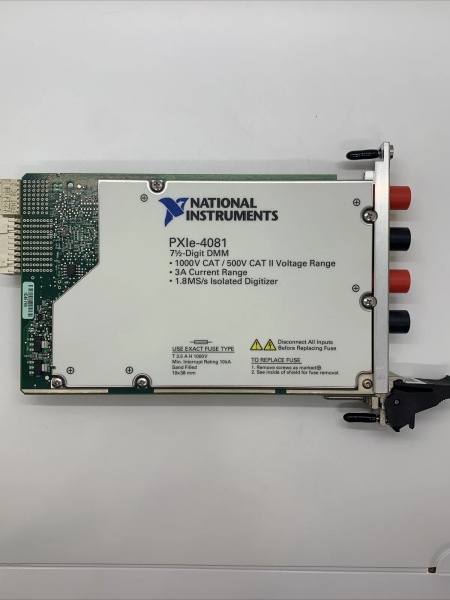
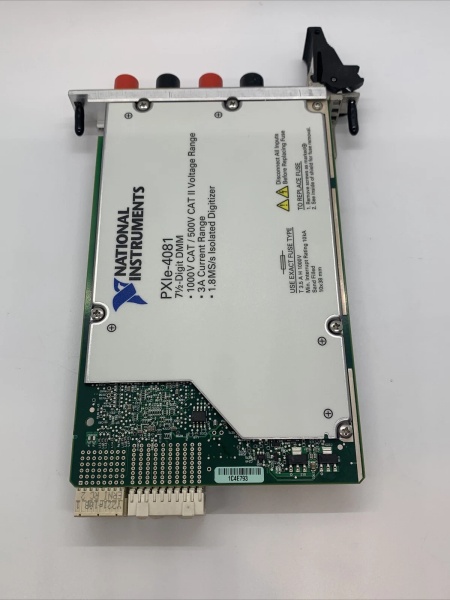
The NI PXIe-4081 783130-01 is a 3U PXI Express module designed for Level 1 (Device) or Level 2 (Control) of the Purdue Model in industrial automation and test systems. It resides in a PXIe chassis (e.g., NI PXIe-1084) and serves as the bridge between test points (e.g., sensors, DUTs) and higher-level systems (e.g., PXI controllers, PCs) for precision measurement and data acquisition.
Upstream Communication
Receives control signals from a PXIe controller (e.g., NI PXIe-8880) via the PXIe bus. These signals include:
-
Measurement Commands: Configure the module for DC/AC voltage, current, resistance, or frequency measurements;
-
Trigger Signals: Synchronize measurements with other devices (e.g., start a measurement after a signal generator outputs a pulse).
Downstream Communication
Transmits measurement data to the controller or PC via the PXIe bus. The module supports two modes:
-
DMM Mode: Outputs high-precision scalar measurements (e.g., 10 nV DC voltage, 1 pA current);
-
Digitizer Mode: Outputs high-speed waveform data (up to 1.8 MS/s) for applications like transient analysis or spectrum monitoring.
Operational Advantages
-
High Precision: 7½-digit resolution (26 bits) enables detection of minute changes in voltage/current, critical for semiconductor testing or nanotechnology research;
-
High-Speed Acquisition: 1.8 MS/s isolated digitizer mode allows capture of fast transients (e.g., power supply glitches) without sacrificing accuracy;
-
Flexibility: Software-configurable measurement modes (DMM/digitizer) eliminate the need for multiple instruments, reducing system cost and complexity;
-
Isolation: Galvanic isolation between the module and chassis protects downstream devices from voltage spikes, ensuring safe operation in high-voltage environments.

NI PXIE-4081 783130-01
Core Technical Specifications
|
Attribute
|
Specification
|
|---|---|
|
Resolution
|
7½ digits (26 bits)
|
|
DC Voltage Range
|
±1000 V (10 nV sensitivity)
|
|
AC Voltage Range
|
±700 V RMS (10 nV sensitivity)
|
|
DC Current Range
|
±3 A (1 pA sensitivity)
|
|
AC Current Range
|
±3 A RMS (100 pA sensitivity)
|
|
Resistance Range
|
10 µΩ to 5 GΩ (2-wire/4-wire)
|
|
Sample Rate (Digitizer)
|
10 S/s to 1.8 MS/s (configurable)
|
|
Input Impedance
|
10 MΩ ± 2% (parallel with 90 pF)
|
|
Aperture Time
|
Configurable (10 ms to 1 s) for trade-off between speed and accuracy
|
|
Operating Temperature
|
0°C to +55°C (32°F to 131°F)
|
|
Storage Temperature
|
-40°C to +71°C (-40°F to 160°F)
|
|
Dimensions (W×H×D)
|
~216 mm × 128 mm × 20 mm (8.5 in × 5.0 in × 0.8 in) (3U PXIe module)
|
|
Weight
|
~0.34 kg (0.75 lbs)
|
|
Certifications
|
CE, UL, CSA, RoHS
|
Customer Value & Operational Benefits
Enhanced Measurement Accuracy
The PXIe-4081’s 7½-digit resolution and low noise floor (e.g., < 100 nV/√Hz at 1 kHz) enable precise measurements of small signals, such as leakage current in semiconductors or voltage drift in sensors. A semiconductor test engineer reported a 30% reduction in measurement error after switching to the PXIe-4081.
Reduced System Cost
By combining a DMM and digitizer into one module, the PXIe-4081 eliminates the need for separate instruments, reducing upfront costs by 20–30%. A research lab using the module saved $5,000 in equipment costs compared to using a standalone DMM and oscilloscope.
Improved Test Efficiency
The 1.8 MS/s digitizer mode allows capture of fast transients in a single shot, reducing test time by 50% compared to traditional DMMs that require multiple samples. An automotive test engineer noted that the PXIe-4081 cut engine control unit (ECU) testing time from 10 minutes to 5 minutes per unit.
Increased Reliability
The module’s galvanic isolation and overvoltage protection (up to 1000 V) prevent damage from voltage spikes, reducing downtime due to equipment failure. A factory floor test system using the PXIe-4081 reported a 99.9% uptime over 12 months.
Field Engineer’s Notes (From the Trenches)
When using the PXIe-4081 for high-resistance measurements (above 100 MΩ), always use shielded cables—unshielded cables can pick up electromagnetic interference (EMI) from nearby power lines, leading to inaccurate readings. I once saw a site where a contractor used unshielded cables, resulting in a 20% error in resistance measurements. Switching to shielded cables eliminated the problem immediately.Another gotcha: enable auto-zero for DC measurements—this compensates for offset drift in the module’s analog-to-digital converter (ADC), improving accuracy by 10–15%. A metrology lab using the PXIe-4081 increased measurement accuracy by 12% after enabling auto-zero.If the module’s “OVERLOAD” LED illuminates, check the input voltage/current—the module has overvoltage (1000 V) and overcurrent (3 A) protection. I’ve fixed countless “overload” errors by reducing the input signal to within the module’s range.NI PXIE-4081 783130-01
Real-World Applications
-
Semiconductor TestingThe PXIe-4081 is used to measure leakage current in MOSFETs and threshold voltage in CMOS devices. Its 1 pA current sensitivity allows detection of tiny leakage currents (e.g., 1 pA) that are critical for semiconductor yield optimization.
-
Automotive ECU TestingThe module is used to test ECU power supply rails and sensor outputs. Its 1.8 MS/s digitizer mode captures fast transients (e.g., voltage drops during cranking) that are essential for validating ECU performance under real-world conditions.
-
Nanotechnology ResearchThe PXIe-4081 is used to measure nanoscale device characteristics (e.g., resistance of carbon nanotubes). Its 10 µΩ resistance sensitivity and 4-wire measurement mode enable accurate characterization of nanoscale materials.
High-Frequency Troubleshooting FAQ
Q: What does the “OVERLOAD” LED indicate on the NI PXIe-4081 783130-01?
A: The red “OVERLOAD” LED indicates that the input signal exceeds the module’s maximum range (e.g., 1000 V DC or 3 A current). Check:
-
Input Signal: Use a multimeter to verify the input voltage/current is within the module’s range;
-
Attenuator Settings: Ensure the module’s attenuator (if used) is set correctly for high-voltage measurements;
-
Cable Connections: Verify the input cables are not shorted or connected to the wrong terminals.
Q: Can the NI PXIe-4081 783130-01 be used with PXI chassis?
A: No, the PXIe-4081 is a PXIe module (PCI Express-based) and is not compatible with PXI (PCI-based) chassis. For PXI systems, use the NI PXI-4080 (6½-digit FlexDMM) instead.
Q: How do I configure the NI PXIe-4081 783130-01 for 4-wire resistance measurements?
A: Follow these steps:
-
Open NI MAX: Launch Measurement & Automation Explorer (NI MAX);
-
Select the Module: Expand “Devices and Interfaces” and select the PXIe-4081;
-
Choose Measurement Type: Under “Measurement Type,” select “4-Wire Resistance”;
-
Set Range: Select the desired resistance range (e.g., 100 Ω to 10 MΩ);
-
Test Measurement: Connect the DUT to the module’s input terminals and start the measurement.
Q: Why is the NI PXIe-4081 783130-01 not acquiring waveform data?
A: Check three things first:
-
Mode Selection: Ensure the module is in “Digitizer Mode” (not “DMM Mode”);
-
Sample Rate: Verify the sample rate is set to at least 10 S/s (the minimum for digitizer mode);
-
Trigger Settings: Ensure the trigger source (e.g., external signal or software trigger) is configured correctly.
Commercial Availability & Pricing
Please note: The listed price is not the actual final price. It is for reference only and is subject to appropriate negotiation based on current market conditions, quantity, and availability.